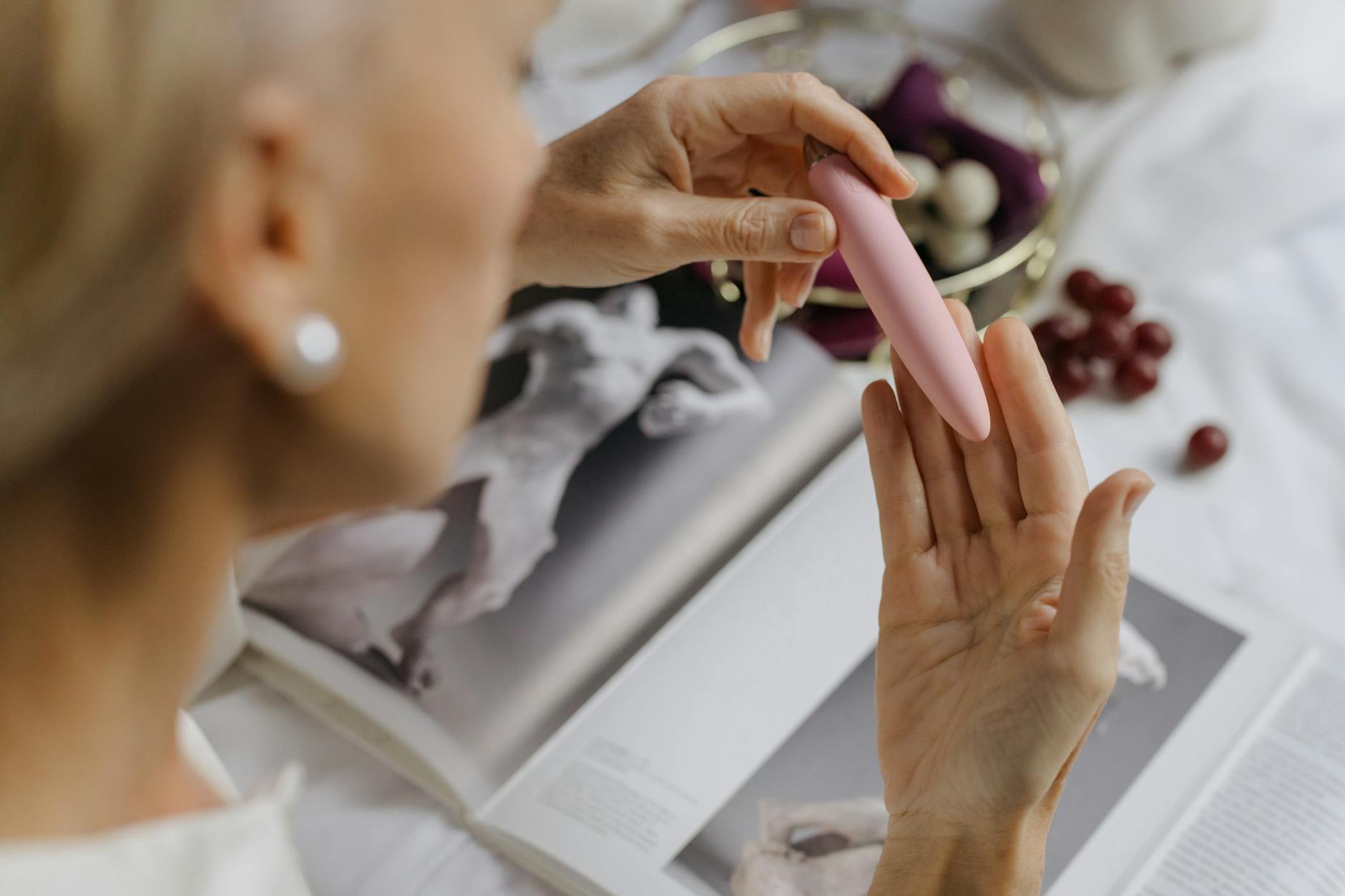
The clock in your head that isn't really there
Here's what happens: your partner initiates. The energy shifts. Your brain immediately registers the unspoken deadline. You have maybe five minutes to "get there" before things feel awkward, or worse, before your partner's disappointment becomes noise in the room. So you rush. Your body doesn't follow. And now you're stuck between two impossible things: the pressure to be ready and the physical reality that readiness takes time.
That tension lives in your nervous system. And it makes arousal nearly impossible.
Why perceived urgency kills arousal
Your sympathetic nervous system (the fight-or-flight branch) activates under time pressure. When you feel rushed, your body prioritizes survival over pleasure. Blood vessels constrict. Lubrication slows. The clitoris, which relies on relaxation and sustained attention to respond, gets starved of exactly what it needs. This isn't a problem with your capacity for pleasure. It's a problem with the context you're trying to have pleasure in.
The research is clear: women with partners who allow longer foreplay report higher arousal, faster orgasm onset once they're aroused, and more consistent orgasms overall. Not because they're more sexually responsive, but because their nervous systems aren't working against them.
The Lem changes the power dynamic
A lemon clitoral vibrator does something specific here. It shortens the gap between initiation and arousal by providing direct, consistent stimulation that your partner's touch (however loving) cannot match. But more importantly, it shifts the emotional script. Instead of "I need to get ready for my partner," the story becomes "I'm choosing my own pace, and my partner is here for it."
That reframe matters more than the vibration itself.
When you introduce a Lemon vibrator into partnered sex, you're saying out loud: my arousal takes time, and that's not a flaw. You're also signaling that you're willing to meet your partner's desire (you're engaged, you're present), just on your own timeline.
How to set this up without awkwardness
Don't wait for the moment. That's the mistake most people make. You're already anxious about timing. Bringing up a vibrator in real time, when pressure is already in the room, feels like a negotiation under duress.
Instead, have the conversation when you're both clothed and the stakes feel lower. "I've noticed I'm in my head about pacing sometimes. I want to try something that might help me relax faster. Would you be into using a vibrator together?"
That's it. Most partners say yes, especially if you frame it as something that makes sex better for both of you (because it does. You're more present. You're actually aroused. The sex is better).
The actual technique
When you're ready to try it, start solo or with your partner present but not inside you yet. Use your Lemon vibrator on its lower settings (pattern 1 or 2) for at least five to ten minutes before your partner touches you. The goal isn't to orgasm. It's to flip the switch from "anxious" to "aroused."
You'll feel the difference. Your breathing shifts. The tension in your pelvic floor releases. Blood flow increases. Your brain stops running the timer.
Once you're genuinely aroused, your partner can join in. They can touch you elsewhere, enter, or you can use the vibrator while they're inside you. The beauty is that you've already met your nervous system halfway. You're not chasing arousal anymore. You're already there.
What this does to the relationship dynamic
Here's what I've noticed clinically: couples who introduce a lemon clitoral vibrator specifically to address pacing pressure often report that the vibrator becomes less necessary over time. Why? Because once your partner sees that you can genuinely relax with support, and once you prove to yourself that your arousal timeline is normal, the anxiety itself decreases.
You stop anticipating pressure because your partner stops applying it unconsciously. They see you aroused. They see you present. They see sex as collaborative rather than performative.
This is how pleasure actually heals in relationships.
If your partner resists the idea
Some partners hear "vibrator" and translate it as "you're not enough." This is worth addressing directly, because it's not about the toy. It's about a fear of inadequacy.
Here's what works: "This isn't about you. It's about my nervous system. When I feel rushed, I can't relax. When I can't relax, I can't enjoy you. This helps me get out of my own way so I can actually be present with you."
That's the truth. And most partners, when they understand the logic, come around.
If your partner continues to resist, that's a different conversation. One worth having with a therapist, because resistance to tools that reduce your anxiety in sex often signals something else going on.
The permission piece
One more thing: using a lemon sexual toy during partnered sex is not a workaround. It's not a compromise. It's a legitimate sexual practice that millions of people use because it works.
You don't owe your partner an apology for your arousal timeline. You don't need to minimize your needs or speed them up to keep your partner engaged. And if your partner can't hold space for your genuine pace, that's information about your relationship, not your sexuality.
A Lemon vibrator is a tool for pleasure. But it's also a tool for boundary-setting. For saying: I matter. My body matters. My timeline matters.
Use it that way.
FAQ
How do I know if partner pressure is actually affecting my arousal?
Notice your body's response. Do you feel tension in your pelvic floor when your partner initiates? Do you find yourself mentally rehearsing how quickly you need to be ready? Do you sometimes fake arousal or orgasm to move things along? Those are all signs that pressure is in the system. The fact that arousal feels easier alone (or with a vibrator) confirms it. Your body isn't broken. The context is wrong.
Can I use the Lem vibrator without my partner knowing?
Yes, though I'd encourage you to eventually have the conversation. Using it secretly can feel like a workaround rather than a solution. But if your relationship is one where you can't talk about sex tools without judgment, that's worth examining separately. A clitoral vibrator is not contraband. It's a health tool.
Will using a vibrator make me dependent on it for arousal with my partner?
No. If anything, the opposite happens. A vibrator helps you reach arousal in a relaxed way, which teaches your body what genuine arousal feels like. Over time, you often need less direct stimulation because you've reconnected with your own capacity. The vibrator is a bridge, not a crutch.
What if my partner wants to use the vibrator but I find it too intense?
Start with lower settings and longer warm-up time. Have your partner use it on you before they use it during sex with you. And be clear: if it doesn't feel good, you can pause and adjust. This isn't about pushing through discomfort. It's about finding your actual edge. A lemon clitoral vibrator has multiple patterns for a reason. Use settings one through three until you find your sweet spot.
How do I bring this up if we've never talked about toys before?
Don't make it a therapy conversation. Make it casual. "I read that vibrators help with arousal timing. Want to try one together?" You can reference this article if it helps. But the simplest opener is honest and low-pressure. Your partner either wants to explore or they don't. If they do, great. If they're hesitant, you can explore why without it becoming a referendum on your relationship.
Can I use a lemon vibrator if I'm on antidepressants that affect arousal?
Yes. Many people find that when SSRIs or other medications dull sensation, a vibrator helps bridge that gap by providing more direct stimulation. How to Use a Lemon Vibrator for Better Sensation When Starting Antidepressants covers this in depth. The vibrator doesn't override the medication's effects, but it can help you access pleasure despite them.
What if I use the vibrator and still don't get aroused?
That's worth investigating separately. Sometimes the issue isn't pacing. It could be medication side effects, relationship distance, depression, or other factors. A vibrator is a tool for sensation. It's not a fix for deeper disconnection. If arousal doesn't come even in a pressure-free context with a vibrator, talking to a therapist or sex specialist makes sense. The good news: you've eliminated one variable (external time pressure), so you can get clearer on what's actually going on.
The real outcome
When you reclaim your arousal timeline, you reclaim your sexuality. That's not dramatic. That's the difference between sex you endure and sex you actually want. A lemon clitoral vibrator can be the thing that makes that shift possible. But the real work is internal: deciding that your pace matters, that your pleasure is worth the conversation, and that a partner worth keeping will want to meet you there. If you're struggling with how to have this conversation with your partner, or if the pressure runs deeper than timing, reach out. Get in touch with support resources that can help you navigate the relationship piece alongside the pleasure piece.